

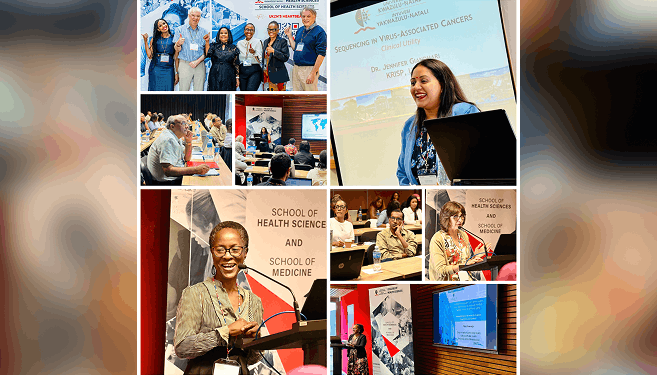
The University of KwaZulu-Natal’s (UKZN) College of Health Sciences (CHS) hosted a three-day international scientific symposium on virus-driven cancers in sub-Saharan Africa (SSA) at the Nelson R. Mandela School of Medicine.
The symposium was hosted in collaboration with the International Centre for Genetic Engineering and Biotechnology (ICGEB), an intergovernmental organisation that supports research, training and technology transfer in the life sciences and biotechnology.
Titled: ‘Translational Virology of Oncogenic Viruses: from Epidemiology to Interventions in Africa’, the meeting adopted a translational approach to highlight the burden of cancers driven by viral infections and to critically examine virus-driven cancer research and interventions in sub-Saharan Africa.
Delegates were welcomed by scientific co-organisers Dr Nokukhanya Msomi and Dr Yanga Mdleleni, Deputy Vice-Chancellor and Head of the College of Health Sciences Professor Busi Ncama, and Dean and Head of the School of Medicine Professor Refiloe Masekela.
International speakers included Dr Mazvita Muchengeti who heads South Africa’s National Cancer Registry, and Professor John Doorbar of the University of Cambridge, who presented on human papillomavirus (HPV) oncogenesis.
Sessions covered topics including HPV-related neoplasms, implementation research, viral hepatitis, gamma-herpesviruses and related cancers. Poster presentations also provided opportunities for critical engagement and discussion.
Head of the UKZN–National Health Laboratory Service (NHLS) Virology Discipline, Msomi, said the 2022 Lancet Oncology Commission Report highlighted Africa’s escalating cancer burden.
“In SSA, a disproportionately high proportion of cancers are associated with viral infections, including liver cancer (hepatitis B and C viruses), cervical cancer (human papillomavirus), and Kaposi sarcoma (human herpesvirus 8). Collectively, virus-associated malignancies accounted for 27% of all incident cancers in 2018, the highest proportion of any WHO (World Health Organization) region,” Msomi said.
“The high burden of HIV in SSA further amplifies this challenge,” Msomi added, “driving the incidence of HIV-associated malignancies such as Kaposi sarcoma, cervical cancer, and non-Hodgkin lymphoma. This creates a syndemic of communicable and non-communicable diseases, in which overlapping epidemics compound vulnerability and health system strain. This occurs despite significant reductions in HIV-related mortality and the large-scale expansion of antiretroviral therapy (ART) programmes across the subcontinent.”
“As populations of people living with HIV (PLHIV) achieve longer life expectancy, the incidence of malignancies in these vulnerable populations continues to rise, shifting the disease burden from primarily communicable diseases to non-communicable morbidity and mortality.”
Local and international presenters responded to these challenges by fostering interdisciplinary dialogue, strengthening translational research pathways and promoting evidence-based interventions linking epidemiology, molecular virology, clinical research and public health implementation.
Symposium organisers Msomi and viral immunologist Mdleleni said they were pleased to host leading national and international researchers working in basic and implementation science.
They said the symposium had strengthened research collaboration between institutions in the Global North and Global South.
The symposium concluded with a diagnostic laboratory visit to the NHLS at Inkosi Albert Luthuli Central Hospital.
Words and photographs: Lunga Memela